


A brief history of Spanish Town
Back in the early 1900s, the area of Park Ridge that would later become known as Spanish Town was a largely undeveloped pasture dotted by a few far-flung homesteads and a greenhouse.
As the town's population grew in the years following World War I, this area (like many others) was subdivided to create homes and properties for new Park Ridge residents. Two ambitious local developers at the time, William Durchslag and Louis Kinsey, created adjacent subdivisions just south of Talcott Road that extended down toward Higgins Road.
And upon this blank canvas, an architectural masterpiece would be painted: Spanish Town.

Bringing Old World Charm to Park Ridge
During a trip to Cuba in the early 1920s, developer William Durchslag fell in love with the Spanish Colonial Revival architecture that was so prevalent there. He marveled at the neoclassical embellishments on Havana's cathedrals, monuments, and residences. And he became intent on bringing this elegant style back to Park Ridge.
Upon his return, Durchslag got to work making his vision a reality. He purchased tracts in the Kinsey subdivision to host his "Spanish Town" project. He researched Old World building techniques and contracted for appropriate materials. And most importantly, enlisted prominent residential architect Benedict Bruns to design the Mediterranean-style homes of Spanish Town.


Some examples of Spanish Colonial Revival architecture in Cuba.
Benedict Bruns leaves his mark on Park Ridge
By the mid-1920s, Bruns had made a name for himself as one of Chicago's bungalow barons. He designed scores of bungalows across the city — in Rogers Park, North Mayfair, and West Ridge — many of which are part of historic districts today. Given Bruns's depth of experience and proven merit as a master home designer, he proved to be the ideal architect for Durchslag's Park Ridge project.

Above: a few of Bruns' bungalows that are part the Rogers Park Bungalow Historic District. Top Right: Bruns property at 2614 W. Morse. Bottom Right: the Bower House that Bruns designed at 2839 W. Wilson.


Advertisement for Spanish Town from Chicago Daily Tribune, May 1927.
Drawing on Durchslag's Cuban inspiration and his own creative sensibilities, Bruns artfully crafted plans for the first twelve-home "unit" of what was to become Spanish Town. In 1925, Park Ridge builders Oliver and Leonard Besinger began
That same year, construction began on Durchslag's capstone to Spanish Town: a Bruns-designed multi-use structure — featuring storefronts on the first level and
construction on those twelve homes. And by 1927, eleven of the homes were nearly complete, with many more intended in the years to follow. Bruns, for his part, so enjoyed Park Ridge that he and his family moved here in 1927.

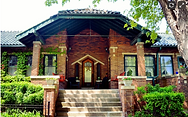
Archival photo of 424 Talcott Place in Spanish Town.
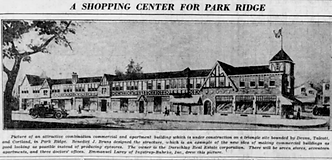

17 apartments on the second floor — at the intersection of Devon, Courtland, and Talcott Road (pictured at right, then and now). As this lovely Tudor building shows, Spanish Town (despite its name) was not going to be limited to Mediterranean styles. Rather, Durchslag intended for the new neighborhood to feature a diversity of Old World styles and architectural influences.
The Great Depression stops Spanish Town in its tracks
By 1929, all twelve homes that made up the first "unit" of Spanish Town were complete, and both Durchslag and Bruns were looking forward to building dozens more.
Unfortunately, the global economy had other plans. Stock markets crashed on Black Tuesday (October 29, 1929), the Great Depression took hold, and all development — in Spanish Town and elsewhere — ceased. So the grand vision that Durchslag and Bruns had for a sprawling Spanish Town, with upwards of 75 homes crafted in Old World style, was never fully realized.

Spanish Town today
Of the twelve Spanish Town homes that were built in the 1920s, eleven of them survive today. (Sadly, the Spanish Town home that once stood at 420 Talcott Place was demolished in 2016.) Generations of Park Ridge residents have lived in and admired Spanish Town. These homes are a point of pride for our neighborhood and town. The folks who are lucky enough to call them home love and cherish them individually and as a self-reinforcing collection.
Although just a fraction of Durchslag's Spanish Town dream came to fruition, the legacy that he did manage to leave to us is a blessing to Park Ridge that is worth protecting.


